
Crawl Space Humidity and Sweating Ductwork in Harnett County Homes
The Psychrometric Physics of Sweating Crawl Space Ducts
For decades, North Carolina residential building codes mandated open foundation vents under the flawed assumption that natural airflow would sweep ground moisture away. In reality, psychrometric physics proves the exact opposite occurs throughout eastern North Carolina from May through September.
Summer ambient outdoor air in Dunn and Erwin frequently registers 90°F with 75% to 85% relative humidity, carrying a atmospheric dew point between 74°F and 76°F. When this hot, moisture-saturated air flows through foundation louvers into a cool, shaded earthen crawl space (typically 68°F to 72°F), its relative humidity spikes toward 100% saturation.
Meanwhile, your central air conditioner pushes chilled 52°F to 55°F air through flexible duct runs beneath your floorboards. If your ductwork has degraded, compressed, or sub-code R-4.2 insulation, the outer vapor barrier surface temperature drops well below 74°F. Moisture instantly condenses out of the air onto the duct jacket—identical to ice water sweating on a drinking glass on a hot porch.
Comparing Foundation Environments: Vented Crawl Space vs. Sealed Encapsulation
Understanding the difference between a traditional vented foundation and a sealed, conditioned crawl space illustrates why modern building science has abandoned open foundation louvers.
| Building Parameter | Traditional Vented Crawl Space (Summer) | Sealed / Encapsulated Crawl Space |
|---|---|---|
| Relative Humidity (RH) | 75% to 95%+ (Saturated conditions) | Controlled at 45% to 55% year-round |
| Wood Moisture Content (WMC) | 19% to 26%+ (Active wood decay range) | Stable at 10% to 14% (Dry, structurally sound) |
| Duct Sweating & Dripping | Severe condensation pooling on vapor barrier | Zero condensation; ducts stay completely dry |
| Subfloor Fiberglass Batt Status | Wet, sagging, detached, mold-colonized | No batts needed; foundation walls insulated |
| First-Floor Air Infiltration | Musty crawl odors pulled up via stack effect | Clean, dry air with dramatically lower allergens |
| HVAC Energy Consumption | 12% to 18% higher due to thermal duct losses | Lower power bills; duct heat gain minimized |
The 4 Costly Consequences of Untreated Underfloor Moisture
Ignoring water pooling beneath your floorboards leads to severe structural and respiratory consequences throughout the home:
- 1. Duct Insulation Collapse: When fiberglass duct wrap absorbs water, the air pockets inside the fiber matrix collapse. Its insulating thermal resistance (R-value) plummets to near zero, causing condensation to accelerate in a vicious cycle.
- 2. Strapping Tears and Collapsed Runs: Waterlogged flexible duct runs can weigh upwards of 50 to 80 pounds, tearing loose from hanging galvanized straps and dragging supply lines into muddy soil.
- 3. Structural Wood Rot and Termite Attractant: Fungi such as Poria incrassata and Serpula lacrymans attack pine subflooring and framing joists whenever wood moisture exceeds 20%, resulting in cupped hardwood floors and sagging tile.
- 4. The Stack Effect: Building science confirms that 40% to 50% of the air breathed on the first floor of a crawl space home is pulled directly from the foundation via the chimney effect through plumbing penetrations and floor seams.
E-E-A-T Field Metric: Testing Wood Moisture Content (WMC)
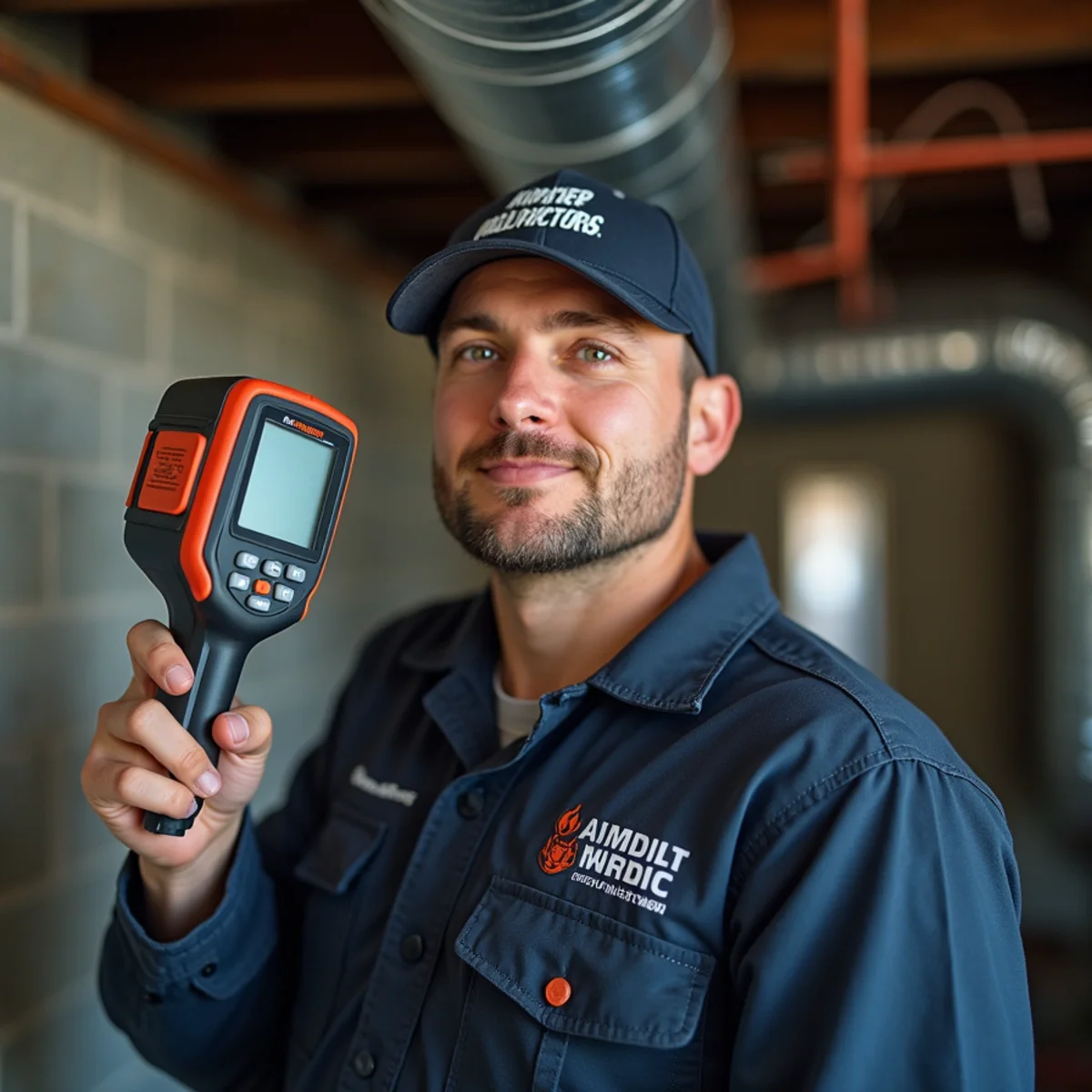
When Averasboro Heating & Air conducts crawl space duct evaluations across Dunn, Benson, and Smithfield, our technicians use digital pin-type moisture meters inserted into subfloor joists. Wood Moisture Content under 15% is completely healthy. A WMC reading between 16% and 19% indicates elevated fungal risk. Any reading over 20% indicates active wood decay and imminent microbial colonization, requiring immediate dehumidification.
Need an HVAC Specialist in Dunn, NC?
3 Proven Steps to Eliminate Sweating Ducts Permanently
Applying duct tape or draping loose plastic over wet ductwork will fail within days. Resolving sweating ducts requires a comprehensive three-part mechanical strategy:
- Step 1: Install Code-Compliant R-8 Insulated Ductwork: Strip away damaged, soaked flex runs and replace them with North Carolina energy code-compliant R-8 insulated ducting. Every sheet metal collar and junction box must be air-sealed with fiber-reinforced elastomeric mastic paste before pulling the vapor barrier jacket tight.
- Step 2: Lay a Continuous 10-to-20 Mil Poly Vapor Barrier: Cover 100% of exposed crawl space dirt with heavy-duty puncture-resistant polyethylene sheeting. Overlap seams by at least 12 inches and seal with waterproof acrylic tape to stop ground evaporation.
- Step 3: Install an Automatic Commercial Crawl Space Dehumidifier: Deploy a high-capacity horizontal dehumidifier (such as an Aprilaire e070 or Santa Fe Compact70) piped directly outside. Set to maintain 50% relative humidity, it eliminates atmospheric moisture and guarantees ducts will never sweat again.
Related Services & Service Areas
Related HVAC Services
Nearby Communities Served
Frequently Asked Questions
Common inquiries related to this guide.
No. Adding new fiberglass over wet or compromised duct insulation traps trapped water against the inner metal or plastic core, accelerating metal rust, destroying tape adhesives, and creating a closed incubator for black mold. Wet insulation has lost its thermal properties and must be cleanly removed and replaced with new R-8 ductwork.
Not urgent? Send a request
Planning a replacement or seasonal tune-up? Fill out the form below. For the fastest help, call (321) 478-0693.